
6 minute read · Exterior painting
Flaking exterior paint needs a cause-and-condition check before repainting. Record where it happens, whether the failure is local or widespread, and what remains on the wall beneath the flakes. A new coat may refresh a sound surface, but it cannot correct trapped moisture, loose render or poor adhesion between older layers.
The useful first question is not "which paint covers this?" It is "what is failing, and why here?" For exterior painting in Dundalk, whole-wall photographs and close-ups of representative patches help start that conversation. An assessment may still be needed before a coating can be specified.
Record where flaking occurs
Mark the affected areas on a simple sketch or a copy of an elevation photograph. Include height, approximate extent and nearby details such as sills, gutter joints, ground level or changes in render. Note whether the same place failed after a previous repaint and how soon the problem returned.
Look for contrasts. Is the sheltered wall sound while the exposed face flakes? Are failures concentrated at a low band, at repaired patches or around openings? Do flakes reveal clean masonry, a powdery layer or another paint colour? These observations help an assessor distinguish possible paths without pretending that appearance alone proves a cause.
| Pattern to record | Question it raises | Do not conclude from the pattern alone |
|---|---|---|
| Below a gutter or sill | Is water reaching the wall here? | That paint is the only problem |
| Low band above paving | What moisture and splash conditions affect it? | That a waterproof topcoat will resolve it |
| Across several old layers | Is adhesion failing within the retained system? | That a spot primer will secure all layers |
| Around recent patches | Were repairs compatible and ready to coat? | That every repair material has the same cure time |
| Isolated exposed edge | Is local wear or a defect responsible? | That all elevations need stripping |
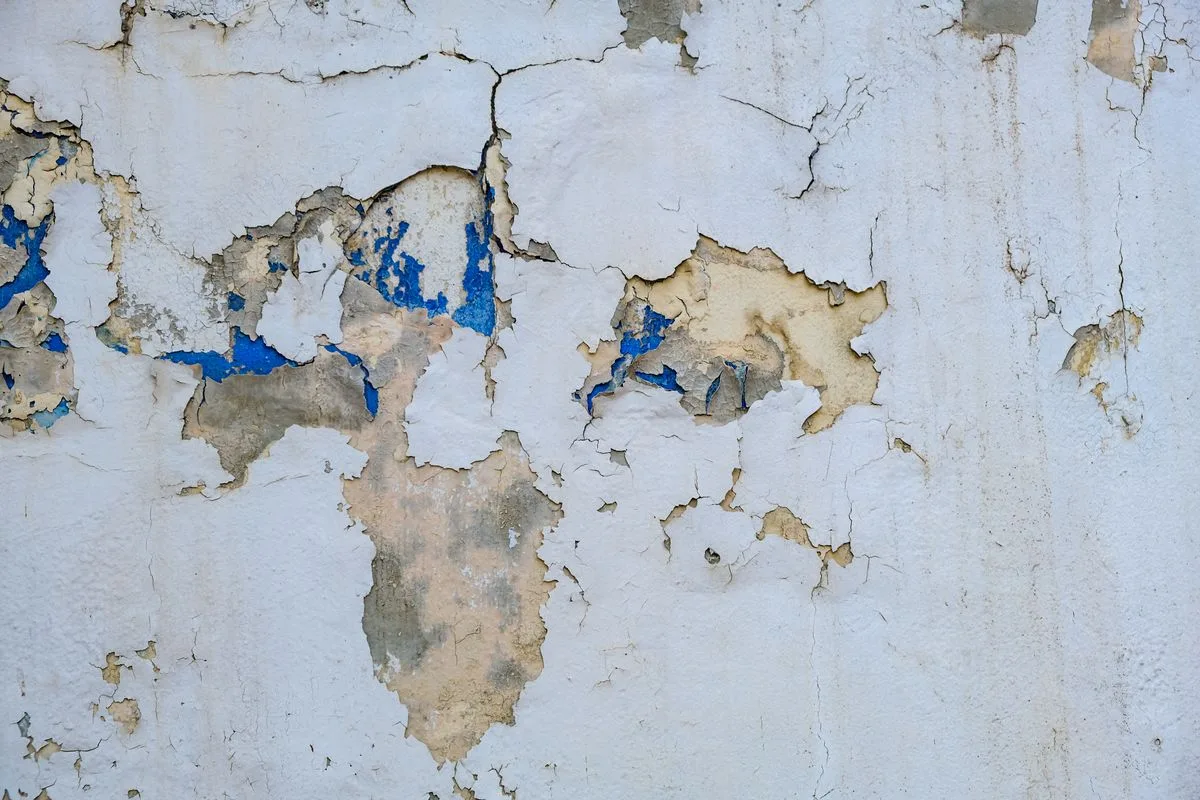
Moisture, adhesion and unsound surfaces
Paint can detach at different interfaces: from masonry, from a powdery residue or between existing paint layers. The remedy depends on which layer is sound enough to retain. A product with strong adhesion cannot strengthen material that is already coming away from the wall.
The Dulux Trade Weathershield Smooth Masonry technical sheet requires sound, clean and dry surfaces and warns about moisture-related risks on particular wall types. It does not position its topcoat as a damp repair. That distinction should remain visible in any proposed repaint.
The Dulux professional guide also distinguishes residual powdering from sound masonry when describing a stabilising primer. A dusty handprint after cleaning may need assessment; it is not proof that the whole wall needs the same sealer.
Possible moisture sources include faulty water-shedding details, direct weather exposure and conditions at the wall base. These require assessment appropriate to the building. Do not seal every face of a damp wall, apply an interior damp product outside or use a high-pressure wash to expose the substrate without checking suitability.
Hollow or loose render, significant cracking and deteriorating masonry move the question beyond paint. A decorative specification should say which repairs must happen first and who is responsible. This guide does not diagnose structural movement or offer remediation.
When repainting should wait
Wait where there is an unresolved leak, active damp, unsound render, unexplained repeated failure or an unknown coating that cannot safely be disturbed. A dry forecast does not resolve those issues. The underlying surface must be ready for the selected system, including any separately repaired area.
The decision need not be all or nothing. A sound separate elevation may be assessed independently while a defective wall waits. However, coating over a failing area to make the house look uniform can hide the evidence needed to establish the cause and may repeat the same failure.
Hypothetical example: paint below one rear sill flakes each winter, while the rest of the elevation remains firm. The useful next step is to investigate that detail and establish the sound boundary, not immediately to specify a stronger whole-house paint. If the sill or adjacent joint needs repair, the decorative work follows after the repair is suitable to coat.
Where old coatings could present a hazard, stop disturbance and seek an appropriate assessment. Do not scrape a large sample, heat the coating or sand it to determine what it is. The HSA lead guidance explains why uncontrolled disturbance of older paint can affect workers and occupants.
What a useful assessment includes
Ask for the assessment to distinguish observed facts from assumptions. "Flaking beneath the window" is an observation. "Water entering at the sill" needs evidence. The proposed scope should explain which existing layers can remain, where preparation is needed and what uncertainty remains until work begins.
- Affected location, extent and any recurring history.
- Substrate and retained coating where identifiable.
- Moisture or building defects requiring another assessment.
- Sound boundary and proposed preparation approach.
- Repair responsibility and readiness before coating.
- Compatible named system once condition is established.
- A plan for discussing additional failure discovered during preparation.
For the actual repaint sequence, continue to exterior preparation. This diagnosis page does not duplicate washing and application instructions because those should follow the condition decision. For later checks, the exterior maintenance guide helps separate ordinary wear from a defect returning in the same place.
Keep dated photos and product records after the work. If the same problem reappears, that history is more useful than a claim that exterior paint should always last a fixed number of years. It also helps explain whether a local repair or a broader review is the sensible next step.
Record the layer that failed
In an assessment note, separate three facts: the visible topcoat colour, the material exposed beneath it and whether nearby retained coating is firm. Those details can distinguish failure within an old paint stack from failure at the masonry surface. Avoid describing every exposed patch as bare render until that has actually been checked.
Practical questions
Does flaking prove that moisture is trapped?
No. Moisture is one possible contributor, while adhesion, contamination and unsound layers can also matter. Record the pattern and underlying surface, then obtain the assessment needed to distinguish them. A photograph of a loose flake is not enough to identify the mechanism or prescribe a damp treatment.
Can I paint the sound walls while one wall waits?
Potentially, if they can be assessed as separate suitable scopes and the wider defect does not affect them. Record the excluded wall and any repair dependency clearly. Consider colour boundaries and access too. A partial repaint should not conceal or imply resolution of the area still awaiting assessment.
Should I keep photographs after a repair?
Yes. Dated context and detail views help distinguish a new defect from the same pattern returning. Keep the product and repair information as well, and record observations without guessing causes. That history is more useful for a future assessment than remembering only the year the house was repainted.
Exterior painting: discuss your surfaces and scope. Contact the team with your area and photographs.