6 minute read · Exterior painting
Choose masonry paint by the wall it must coat: the render or brick type, the existing finish, moisture conditions and the manufacturer's approved system. Colour and the largest coverage figure come later. No single paint is the right choice for every Irish wall.
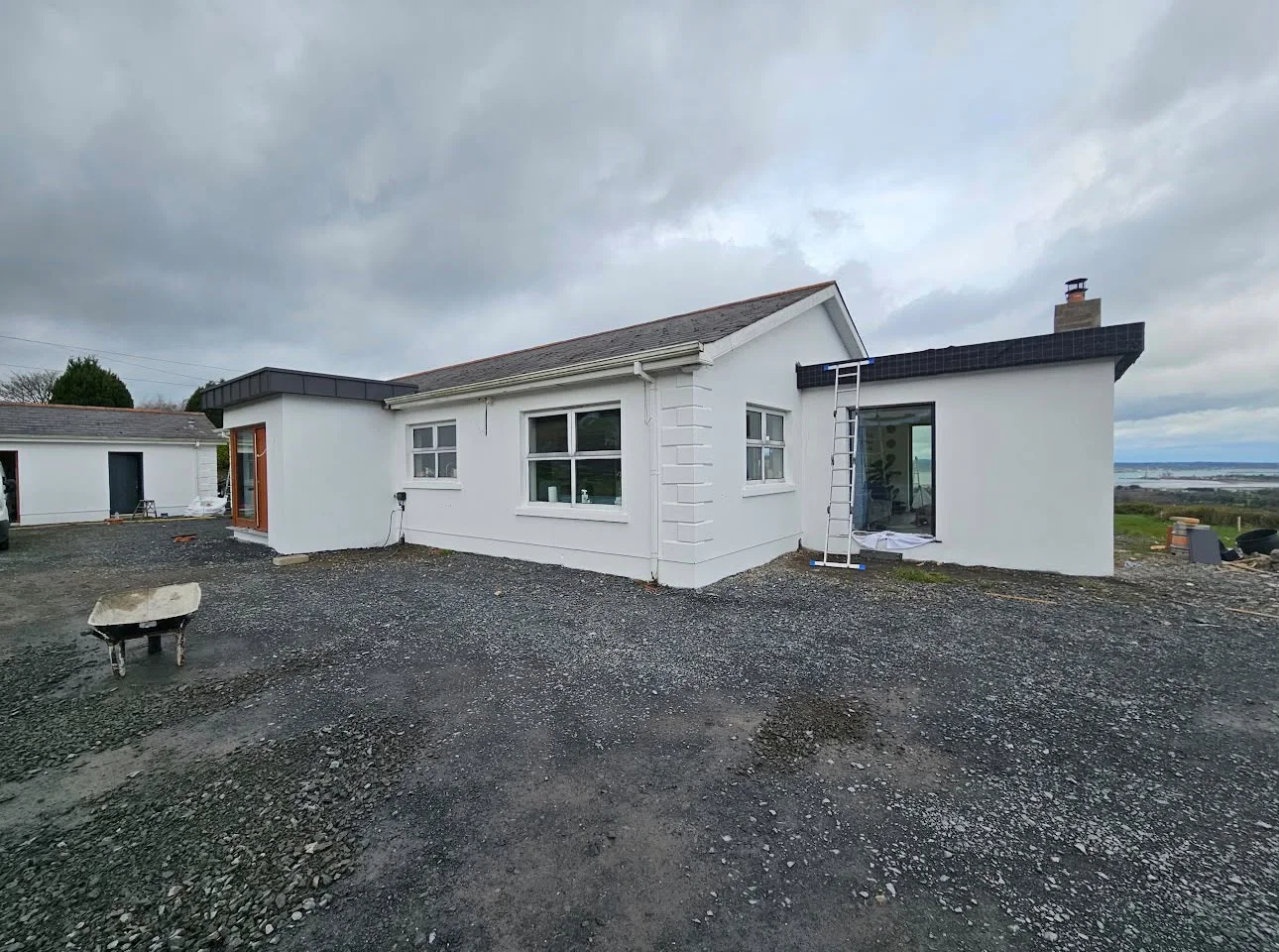
A sound modern rendered wall, a traditionally built lime-rendered wall and a free-standing garden wall can require different decisions. Identify what you have before selecting a product. For exterior painting in Dundalk, photographs and any existing product records are useful starting information.
Start with render, pebbledash or existing coating
Name the substrate as accurately as possible. If uncertain, supply a close-up and a full elevation photo rather than guessing. Record whether the wall has been painted and what remains underneath loose areas. A product suitable for bare render may have different preparation requirements over retained coating.
For proprietary coloured render, exterior insulation or a specialist finish, seek the system supplier's guidance. An ordinary masonry label does not prove compatibility. Traditional lime-based construction needs particular care because moisture movement and the existing fabric matter more than a general claim that a paint is "breathable".
| Wall condition or type | First selection question | Avoid assuming |
|---|---|---|
| Sound modern render | Which current systems approve this substrate? | That every primer is necessary |
| Previously painted dash | What retained coating is sound and compatible? | Headline smooth-wall coverage will apply |
| Traditional lime-based wall | What conservation-compatible approach suits the fabric? | A generic breathable label is enough |
| Proprietary render or insulation system | What does its supplier permit? | Any exterior emulsion is acceptable |
| Free-standing or retaining wall | What moisture exposure and restrictions apply? | A house-wall product covers this use |
For texture differences, see painting pebbledash and render. If the old finish flakes, begin with the failure assessment rather than trying to choose a stronger topcoat first.
Compare current technical data
Read the technical sheet as a set of permissions and limits. Check approved substrates, unsuitable surfaces, retained-coating requirements, preparation, primers, coat build, application method, weather restrictions and coverage assumptions. A marketing page may omit the exclusions that decide whether the product suits your wall.
The Dulux Trade Weathershield Smooth Masonry technical sheet names roughcast and pebbledash among qualified uses and excludes certain brick types. It also warns about moisture risks on some free-standing and retaining-wall situations. The useful comparison is the exact permission and limitation, not the brand name alone.
The Little Greene Intelligent Masonry page presents a water-based matt system with its own preparation and application information. Its coverage and finish should be read as properties of that formulation. Neither example is ranked here as universally best.
Do not compare a maximum coverage figure on smooth low-porosity render with actual coverage on deeply textured dash. Likewise, do not compare a shower-resistance statement with another product's recoat time as though they were the same performance measure. Ask what each number actually describes.
Check the sheet revision and product name, including Trade versus retail distinctions. An old PDF held by a stockist can still explain a principle but should not overrule a current local specification. Formulations and product ranges can change.
Exposure and maintenance questions
Assess the actual exposure: sheltered recesses, open elevations, nearby trees, splashback and water-shedding details. Do not assume that every property near Dundalk has the same conditions or that an entire county needs one specialist coating. A recurring wet patch needs investigation rather than a more emphatic weatherproofing claim.
A paint-film feature aimed at resisting algae does not repair a leak or guarantee that no growth will appear. Similarly, a long protection claim depends on the product's stated preparation, conditions and exclusions. Keep the maintenance plan tied to visible wear and the actual system rather than promising a universal repaint interval.
Hypothetical comparison: Product A is approved for the identified render and the sound retained coating, while Product B offers a larger colour range but has no confirmed compatibility with the existing system. Product A is the clearer starting option unless technical support resolves B's uncertainty. The missing permission matters more than the extra swatches.
Traditional buildings deserve a separate route. The Irish Architectural Heritage Protection Guidelines explain concerns about impermeable coatings on historic masonry. If the property or its setting has conservation restrictions, establish the appropriate advice and permissions before changing the finish.
Confirm Irish availability and system support
Once the candidate system is suitable, confirm that the required colour, base, primer and finish are available through the intended Irish supplier. A UK product page is not a guarantee of local stock or an identical regional product. Keep the actual label and technical documents together.
- Exact product and regional version.
- Identified substrate and retained coating.
- Preparation and repair dependencies.
- Required primer or undercoat, if any.
- Coverage allowance for the actual texture.
- Weather and drying requirements for every stage.
- Colour sample, pack availability and maintenance record.
If two systems remain suitable, compare the full material specification and practical application requirements. A cheaper tin can be poor value if the calculation ignores coverage or required associated products. Material retail cost is also separate from the labour and access in the quotation.
The final specification should be understandable: what surface is being painted, what preparation is needed and which complete system will be used. You do not need to become a coatings specialist to ask for those essentials.
A compact specification worksheet
Before comparing two candidates, write one sentence for each of these fields: wall construction, visible finish, known previous coating, condition, exposure, necessary repairs and desired appearance. Then add a column for each product and mark whether its technical information answers the relevant question. Leave an unresolved permission blank rather than assuming approval. For example, a product may clearly permit cement render but provide no answer for the existing proprietary finish. That blank identifies the next question for its supplier. It is more useful than awarding points for attractive colours or a long protection claim while the substrate question remains unsettled.
Practical questions
Is breathable paint automatically suitable for an old house?
The word alone does not establish compatibility with the construction, existing coatings or conservation needs. Identify the wall and seek appropriate technical or conservation advice where relevant. Compare meaningful system data and substrate permissions instead of using a broad marketing description as a complete specification.
Can masonry paint be used on a retaining wall?
Only if the actual product and wall situation are suitable. Moisture can enter from behind, above or below, and some systems warn against particular retaining or free-standing wall uses. Assess the wall conditions and restrictions first rather than transferring approval from a dry house elevation.
Should I choose the highest coverage figure?
Not without checking what surface and conditions that figure describes. A maximum on smooth low-porosity render is not a promise for rough or absorbent masonry. Compare the complete system and realistic material requirement, including preparation and any associated primer, before deciding which product offers value.
Exterior painting: discuss your surfaces and scope. Contact the team with your area and photographs.